At Veriteer, we've spent years working alongside brands of every scale, from multi-billion euro global enterprises to ambitious high-growth businesses, helping them connect strategy to execution. And if there's one pattern we see more than any other, it's this: the organisations that consistently outperform their competitors are the ones that have learned to orient every decision, every resource, and every team around clearly defined outcomes.
This isn't a new idea. But it is a persistently misunderstood one. Becoming outcome-led is not about adopting a goal-setting framework, hanging OKRs on the wall, or renaming your KPI dashboard. It is a fundamental shift in how an organisation thinks, prioritises, and operates - a change that is simultaneously technical, operational, and cultural.
Why outcomes matter more than ever
In an era of constant disruption, the organisations that thrive are not the ones with the best plans. They're the ones with the clearest sense of what they're trying to achieve and the most disciplined approach to getting there.
The evidence for this is not just anecdotal. Research in goal-setting theory, most notably the work of Edwin Locke and Gary Latham spanning over fifty years, has consistently demonstrated that specific, challenging goals produce significantly higher performance than vague aspirations or simple "do your best" instructions. Across more than a thousand studies, the finding holds: clarity of outcome focuses attention, mobilises effort, and encourages the kind of strategic thinking that activity targets simply do not.
The real-world proof is equally compelling.
When Andy Grove took the helm at Intel in the late 1970s, the company was losing ground to Motorola in the microprocessor market. Grove's response wasn't to work harder on existing plans — it was to reorient the entire company around a single, measurable outcome. Through "Operation Crush," Intel set clear objectives and key results at every level of the organisation, from senior leadership to individual sales engineers. The result was decisive: Intel recaptured 85% of the 16-bit microprocessor market by 1986 and went on to become the dominant force in computing. Under Grove's outcome-led leadership, Intel's market capitalisation grew from $4 billion to $197 billion.
When John Doerr later brought the same outcome-led discipline to a thirty-person startup called Google in 1999, the results were similarly transformative. Larry Page would later write that OKRs helped Google achieve "10x growth, many times over" and made its audacious mission of organising the world's information "perhaps even achievable." Google's radical transparency around outcomes — where every employee, including Page and Brin themselves, published their objectives for the entire company to see — created an alignment and focus that powered one of the most extraordinary growth stories in business history.
Closer to the public sector, the UK Government adopted Outcome Delivery Plans across all departments following the 2020 Spending Review. The shift was telling: rather than holding departments accountable for activities and process compliance, each department was required to articulate its priority outcomes and demonstrate a credible strategy for achieving them. Cross-cutting outcomes were agreed between departments, reflecting the reality that meaningful results rarely respect organisational boundaries.
These aren't isolated examples. They reflect a consistent truth: organisations that define what success looks like — in concrete, measurable terms — and then organise themselves to pursue it, dramatically outperform those that simply manage activity.
The five characteristics of an outcome-led organisation
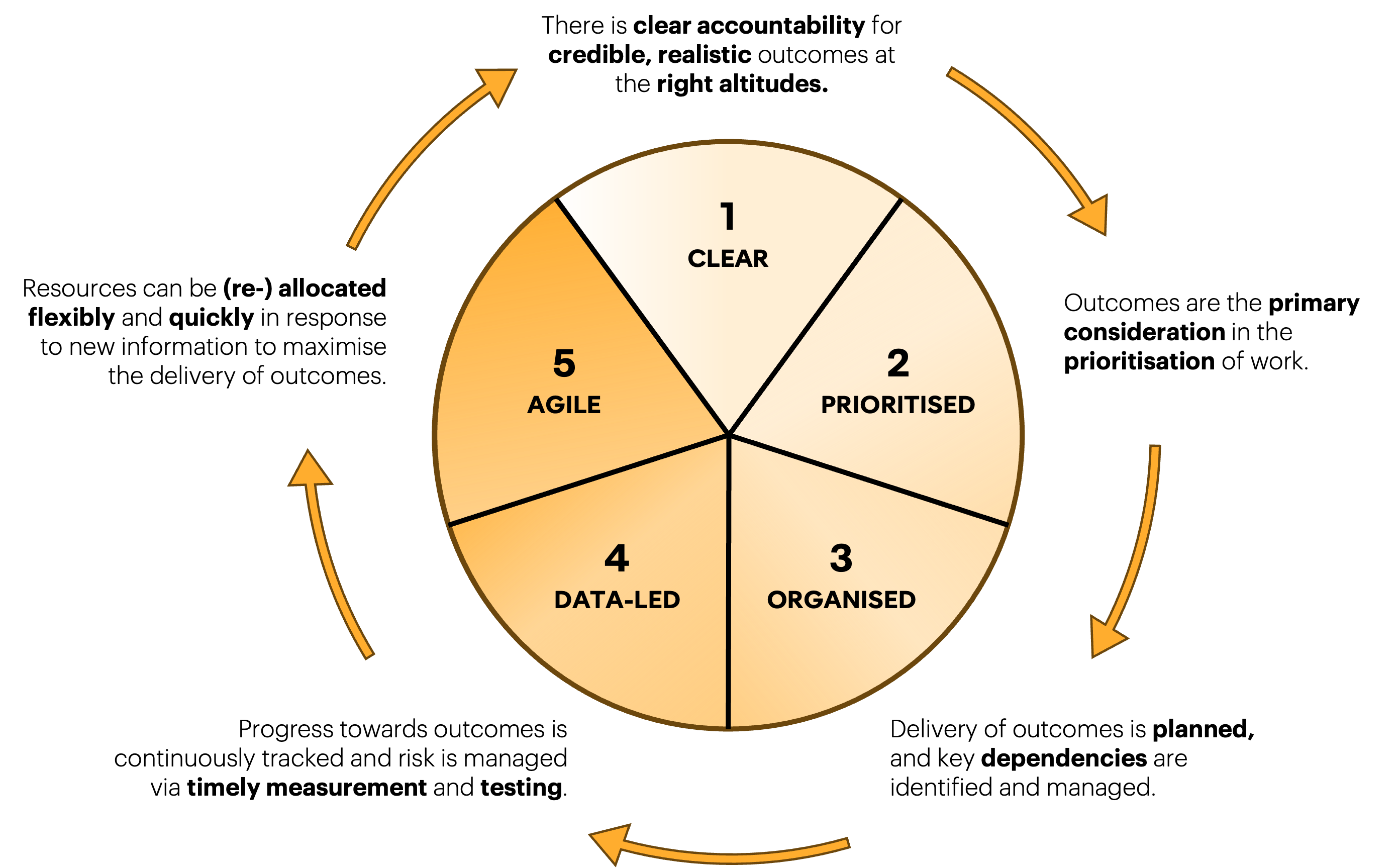
Through our work with brands across sectors, we've distilled the characteristics that distinguish genuinely outcome-led organisations into five interconnected principles. Together, they form a reinforcing cycle — each one enabling and strengthening the next.
1. Clear
There is clear accountability for credible, realistic outcomes at the right altitudes.
This is where it starts, and where most organisations stumble first. Outcomes must be set at the right level of abstraction — not so high that they become meaningless mission statements, and not so granular that they collapse into task lists. A good outcome describes a change in state: a market position shifted, a customer behaviour altered, a capability established.
Equally critical is accountability. Every outcome needs an owner — someone with the authority and resources to pursue it, and the responsibility to report on progress honestly. When accountability is diffuse, outcomes become aspirations. When it is clear, they become commitments.
2. Prioritised
Outcomes are the primary consideration in the prioritisation of work.
In the activity-led organisation, work is prioritised by urgency, internal politics, or the enthusiasm of its sponsor. In the outcome-led organisation, every initiative is evaluated against its expected contribution to stated outcomes. This demands a common framework for comparing unlike things — how do you weigh a compliance initiative against a revenue growth experiment against a platform migration?
The answer lies in making trade-offs visible and criteria explicit. Without outcome-led prioritisation, organisations default to trying to do everything, which is the same as having no priorities at all.
3. Organised
Delivery of outcomes is planned, and key dependencies are identified and managed.
Outcomes don't exist in isolation. They interact, conflict, and depend on one another. A growth outcome might depend on a technology platform that is itself the subject of a separate outcome. A customer experience improvement might require changes across multiple teams, channels, and systems.
Outcome-led organisations map these dependencies deliberately, build delivery plans that account for them, and create governance structures that can manage the inevitable tensions between competing priorities.
4. Data-led
Progress towards outcomes is continuously tracked and risk is managed via timely measurement and testing.
You cannot be outcome-led if you don't know whether you're making progress. This sounds obvious, but many organisations define outcomes and then fail to establish the measurement infrastructure needed to track them. The result is that they revert to measuring what's easy — activity, output, compliance — rather than what matters.
Data-led organisations invest in leading indicators, not just lagging ones. They test assumptions early through experimentation and prototyping. They build feedback loops that allow them to course-correct before it's too late, rather than discovering at the end of a programme that the expected benefits haven't materialised.
5. Agile
Resources can be reallocated flexibly and quickly in response to new information to maximise the delivery of outcomes.
The final characteristic is perhaps the most culturally challenging. In many organisations, once a budget is allocated and a plan is set, changing course is treated as failure. In outcome-led organisations, changing course is treated as intelligence.
If the data shows that an initiative isn't delivering the expected outcome, the response isn't to continue funding it out of sunk-cost loyalty — it's to redirect resources to where they'll have the greatest impact. This requires not just the operational mechanisms for reallocation, but a culture that values adaptation over adherence.
The cycle of reinforcement
These five principles don't operate in isolation. They form a reinforcing cycle: clarity enables prioritisation, prioritisation enables organisation, organisation enables measurement, measurement enables agility, and agility drives the next cycle of clarity as new information reshapes understanding of what outcomes are achievable and what they require.
Organisations that master this cycle don't just perform better against their stated goals. They develop the institutional capacity to adapt when those goals need to change — which, in today's environment, they inevitably will.
Making it personal: the individual shift
Organisational outcomes don't deliver themselves — people do. One of the most underestimated aspects of becoming outcome-led is the shift required in how individuals understand their own contribution.
In activity-led cultures, people define their value by what they do: tickets closed, meetings attended, documents produced. In outcome-led cultures, people define their value by what changed as a result of their work. This is a profound reframe, and it requires deliberate practice.
The most effective approaches we've seen involve connecting every team's objectives visibly to the organisational outcomes they serve, so the line of sight from individual effort to strategic impact is never abstract. Regular reflection rituals — not status updates, but genuine inquiry into whether work is producing the intended effect — build the muscle of outcome thinking over time. And critically, leaders must model the behaviour by asking "what outcome did this achieve?" rather than "what did you deliver?"
Self-Determination Theory, developed by Edward Deci and Richard Ryan, provides a useful lens here. Their research shows that people are most motivated and effective when they experience autonomy, competence, and relatedness. A well-implemented outcome-led approach serves all three: it grants teams autonomy over how to achieve results, builds competence through measurable feedback loops, and creates relatedness by connecting individual work to shared purpose.
When the Gates Foundation adopted OKRs in the 2000s, Bill Gates found that the framework helped him make sharper decisions, including rejecting grant proposals where the goals weren't sufficiently clear. The discipline of outcome thinking didn't constrain the Foundation's ambition — it sharpened it, ensuring that resources went to where they could make the greatest measurable difference.
The real competitive advantage
Becoming outcome-led isn't a methodology you install. It's a way of operating you build — through sustained attention to how goals are set, how work is prioritised, how progress is measured, and how people understand their own contribution.
The organisations that do it well don't just hit their targets. They develop the institutional reflexes to navigate uncertainty, to make hard trade-offs with confidence, and to adapt when the world changes around them.
That capacity — to know what you're aiming for and to reorganise in pursuit of it — is the real competitive advantage. And in our experience, it's rarer than it should be.
Further reading
- Locke, E.A. & Latham, G.P. (2002). "Building a Practically Useful Theory of Goal Setting and Task Motivation: A 35-Year Odyssey." American Psychologist, 57(9), 705–717. APA PsycNet
- Deci, E.L. & Ryan, R.M. (2000). "The 'What' and 'Why' of Goal Pursuits: Human Needs and the Self-Determination of Behavior." Psychological Inquiry, 11(4), 227–268. Taylor & Francis
- ISO 21502:2020 — Project, programme and portfolio management — Guidance on project management. International Organization for Standardization. ISO catalogue
- UK Government (2021). Outcome Delivery Plans. GOV.UK. Collection page
- Drucker, P.F. (1954). The Practice of Management. Harper & Row. — The foundational text on Management by Objectives, from which modern outcome-led practice descends.